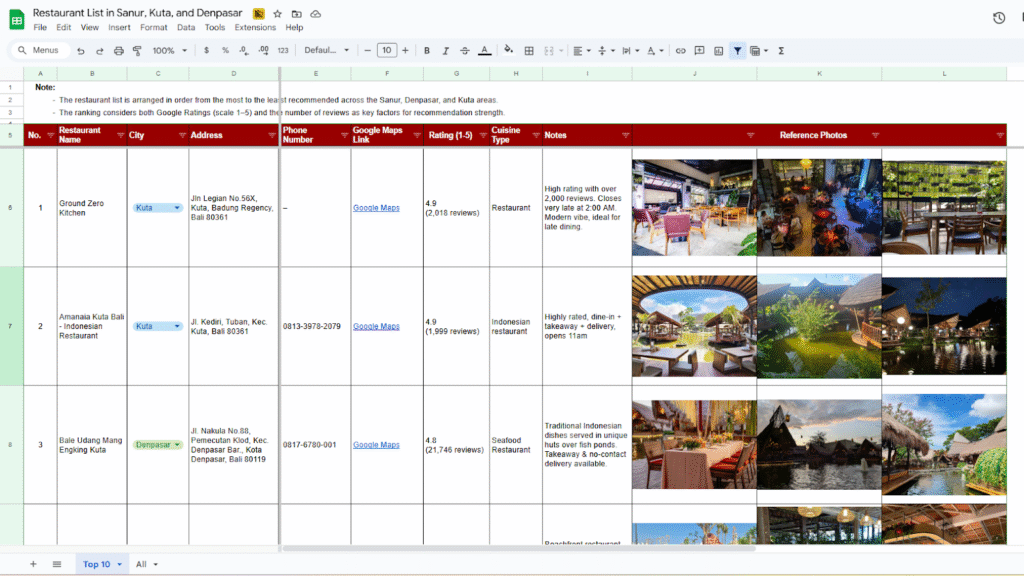
A Data-Driven Curation for Smarter Local Dining Insights
Finding the best restaurants in a tourist-heavy area like Bali can be overwhelming, especially when online ratings don’t always tell the full story. For this project, I curated and ranked 52 restaurants across Sanur, Kuta, and Denpasar, combining public data from Google Maps with a Bayesian-based ranking methodology.
What I Did?
- Collected 52 restaurants from Google Maps, including ratings, reviews, and addresses.
- Ranked them using a Bayesian average, balancing both the score and number of reviews.
- Verified and classified all restaurant addresses under Sanur, Kuta, or Denpasar based on subdistricts, districts, cities, and postal codes.
- Standardized location data to support clean filtering and accurate area-based grouping.
- Delivered the output in a Google Spreadsheet with two sheets:
- Top 10 Recommended Restaurants
- Full Restaurant Listing
Why It Matters?
Most “top restaurant” lists don’t account for data bias. A new venue with just five 5-star reviews may rank above an established place with thousands of solid reviews. My approach corrects that using the Bayesian average formula, resulting in fairer, more reliable recommendations.
This list can be used for:
- Travel guides or local directories
- Location-based restaurant apps
- Real estate or hospitality projects targeting lifestyle zones in Bali
Final Thoughts
This was more than a simple list, it was an opportunity to bridge data and local context. While tools like Google Maps offer rich data, human validation is still essential to make that data accurate and useful. I’d love to expand this into other areas in Bali or integrate deeper layers like cuisine types, menus, or ambiance.
If you’re working on something similar and need help with data curation, location mapping, or research-based content, let’s talk!
Want to see the full process, methodology, and detailed report? See below document.